Federated Synthetic AML Data: 12x lift, zero real data
Federated synthetic AML data is the latest federated product launching from Consilient this year, and is built to close the one problem every AML program shares: not enough crime data.
No bank has enough real examples of every financial-crime type it needs to detect. Not the smallest community bank. Not the largest money-center institution in the country. We proved it, then we built the fix.
Synthetic data creates realistic examples where real labels are scarce. Federation allows that capability to learn from experience distributed across participating institutions, while the underlying customer and transaction data stays local.
At a glance
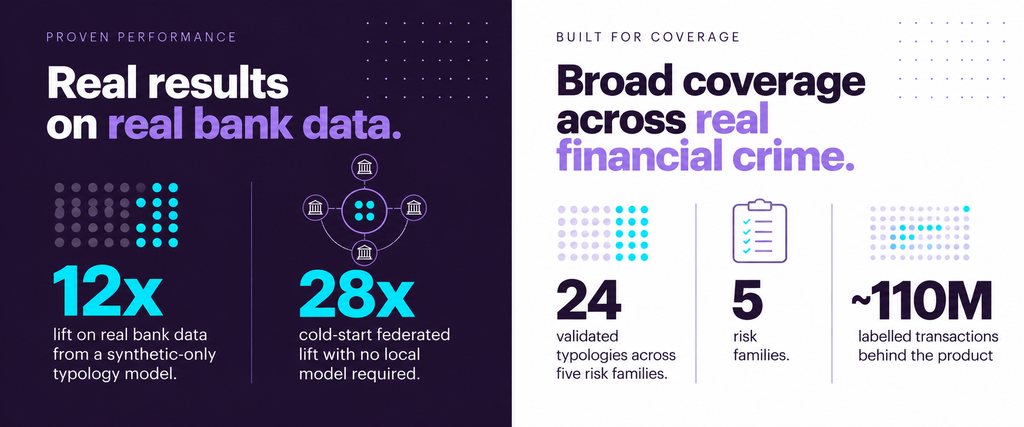
- 12x lift on real bank data from a synthetic-only typology model
- 28x cold-start federated lift, with no local model required
- 24 validated typologies across five risk families
- ~110M labelled transactions behind the product
Synthetic data solves scarcity. Federation solves fragmentation.
That’s the idea behind Federated Synthetic Data. The financial crimes under the most scrutiny today, including trade-based laundering, corruption, and sanctions evasion, are the same ones every AML program has the least data on, at every institution, regardless of size.
The largest institutions may have thousands of examples of their most common financial crime types, but far fewer for the long tail of rarer and emerging risks. Mid- and small institutions face a shortage across all risks.
That’s why we brought two capabilities together.
We tested it against a real bank
Before this became a product, it started as a research question: how much data does an AML model need before it stops improving?
We trained a set of detection models on nothing but synthetic data, zero real transactions, zero real customers, then tested them against a real bank’s accounts.
Confirmed suspicious accounts ranked 10 to 15 times better than random chance, with no real customer data anywhere in training. It worked where the financial-crime type matched how that bank’s customers behave, and stayed honest where it didn’t.
When the synthetic scores were combined with the bank’s existing model, detection improved further, and the improvement passed a formal statistical test.
Read the full research: How much data does an AML model need to catch financial crime?
Federation turns synthetic data into a learning system
Synthetic data can provide the examples an institution does not have. But financial crime does not stand still, and no synthetic dataset should be treated as a finished picture of the world.
That is where the combination of synthetic data and federation becomes fundamental.
It pairs two things that tackle this shortage from different angles, and are stronger together.
Synthetic scenarios turn regulatory intelligence, casework, and typology expertise into model-ready training data, without touching a single real customer record.
Federation does the rest. Every institution trains its models locally, on its own data. Only the approved model learning, never the underlying customer or transaction data, travels into the network. That learning is combined and returned as stronger detection capability to every participant.
One institution’s experience strengthens the network. The network’s experience strengthens every institution.
What that unlocks:
- 🟣Day-one detection for new and emerging risks, live before an institution has built up its own history on a typology.
- 🟣Coverage where internal labels are scarce or absent, on exactly the crime types every bank struggles with most.
- 🟣Controlled stress tests for existing rules, models, and vendors, run against realistic conditions without touching real customer data.
- 🟣Network learning that allows detection capability to strengthen as participating institutions encounter new patterns and variations.
Validated. Not asserted. Every synthetic data package is tested for behavioral plausibility, distributional overlap, leakage controls, and model non-triviality before it’s used. That’s key because synthetic data can be dangerously easy to make look good.
A model that achieves near-perfect performance may simply have learned the artifacts of the generator rather than the behavior of financial crime.
The real-bank testing gives us a harder benchmark: does synthetic learning transfer to real financial behavior?
The results show that it can.
Built for a problem no institution can solve alone
No institution, regardless of size, has enough real-world examples of every financial-crime type it’s responsible for detecting. And even collectively, those examples are distributed across institutions that cannot simply pool their customer data. Building synthetic data is part of the solution to improve model performance. Synthetic data creates the examples models need. Federation enables learning from broader institutional experience without centralising the underlying data.
Today, Federated Synthetic Data is already validated across 24 typologies and roughly 110M labelled transactions, with federation providing the mechanism through which it continues to strengthen and giving programs that coverage from day one.
If you want to see where your own institution sits against these thresholds, talk to our team about what Federated Synthetic Data could add on top of what you already run.
Talk to us about Federated Synthetic Data.
What’s next
Federated Synthetic Data is the first of three federated products launching from Consilient this year.
Next up: an enhanced risk intelligence agent for correspondent banking, and a tool that turns SAR and STR narratives into new detection capability.
Get notified when the next product launches. Follow us on LinkedIn.
