Gold laundering, FATF, and UNODC: the 2026 AML agenda for banks
I sat through FATF’s launch of its 2026-2028 agenda earlier this month. $1 trillion is the number FATF opened with. That’s what scams cost globally in a single year. That’s what they want to change, and they name cross-border data sharing as one of three priorities in that agenda, alongside a fresh commitment to risk-based supervision.
Then I went back to what UNODC has been saying about minerals crime. In June, under UN General Assembly Resolution 80/227, illegal mining and mineral trafficking were placed before the General Assembly alongside timber, fisheries, and waste crime, framed as a security, justice, and state authority issue. A new IISS report puts a number on the scale UNODC is describing: illicit gold mining now generates proceeds between $12 billion and $48 billion a year, a range that’s climbed alongside gold prices, which are up more than 182% over the past five years.
So, two institutions. Two agendas, published weeks apart. Same diagnosis.
Illegal gold trafficking creates a fragmented trail. Before gold reaches a refinery, information about its extraction, ownership and movement can sit across miners, intermediaries, exporters, customs authorities and financial institutions, often in different jurisdictions. Somewhere along that chain, illicit gold has to acquire a legitimate-looking origin if it is to enter the formal market.
Refining is a critical point in that journey. Once illicit gold is refined and mixed with gold from legitimate sources, tracing its physical origin becomes extremely difficult. But the value does not disappear. Someone has bought the gold, someone has been paid, and the proceeds ultimately have to move through the financial system. As the physical trail becomes harder to follow, the documentary and financial trail becomes increasingly important, creating signals across institutions that no single participant may be able to see alone.
| Key takeaways from this article: UNODC has placed illegal gold mining and mineral trafficking before the UN General Assembly under Resolution 80/227, treating it as a security, justice, and state authority issue. Five named typologies drive the trade: illegal extraction, origin mislabelling, false documentation, corruption, and laundering through supply chains that present as legitimate. Refining and mixing can make the physical origin of illicit gold extremely difficult to recover, increasing the importance of connecting financial and documentary signals across institutions. FATF’s 2026-2028 agenda puts fraud and cross-border information sharing at its center, one of three named priorities under the incoming UK Presidency. Gold and mineral-linked trade finance clients should expect more scrutiny as ESG and AML risk functions land on the same underlying data problem from two different desks |
The UN is treating illegal mining as an organised-crime problem
UNODC’s Global Analysis on Crimes that Affect the Environment, Part 2b treats illegal gold mining as organized crime. Not a side effect of it. The report itself.
In June, under General Assembly Resolution 80/227, UNODC put minerals, timber, fisheries, and waste crime before the UN General Assembly. The framing was deliberate: security, justice, and state authority, well outside the conservation bracket these crimes have historically been filed under.
For banks, that reframe changes where this risk sits on the org chart. Gold sourcing has lived in ESG and sustainability functions for years, filed as a supply chain integrity question. UNODC’s placement drags it into financial crime territory, alongside the same actors, the same laundering mechanics, and the same reporting obligations as any other organized crime typology.
The report backs that placement with who’s actually involved. Latin American drug trafficking organisations have moved into illegal gold mining, reusing the smuggling routes and infrastructure built for narcotics. In parts of Africa, some groups run gold operations as their primary business. Others use gold profits to fund armed conflict directly.
The scale of the problem
- Illicit gold mining generates an estimated $12 billion to $48 billion annually, a figure likely understated given widespread under-reporting.
- Gold prices are up 182%+ over five years, directly increasing the profitability of illegal mining.
- In Peru alone, illicit proceeds from illegal gold mining nearly tripled, from $4.8 billion in 2024 to $12 billion in 2025.
- More than 80% of financial institutions have exposure to illegal mining risk, yet 40% aren’t yet taking steps to address itIn Colombia, illegal gold mining now generates more profit for organized crime than cocaine
The five named typologies, and why gold is the hard case
UNODC’s own language, repeated again in its June 2026 update on mining industry exposure, names five mechanisms driving this trade:
- Illegal extraction — mining outside licensed concessions, often on land where the state has no real enforcement presence to begin with
- Origin mislabelling — the point where illicit and licit gold physically converge into the same bar
- False documentation — forged permits, fabricated chain-of-custody paperwork, export certificates issued for gold that never passed through the stated concession
- Corruption — payments to secure concessions, or to make violations already committed disappear from the record
- Laundering through supply chains that present as legitimate — the umbrella mechanism the other four feed into
Corruption and false documentation aren’t separate failure points sitting side by side. Corruption is what gets the false documentation issued in the first place. A bribed official signs off on a certificate that shouldn’t exist, and from that point on, every downstream buyer, refiner, and exporter has a paper trail that looks clean because someone was paid to make it look that way.
Origin mislabelling is the mechanism that makes the other four survive contact with a refiner. Once illicit gold is refined and mixed with legitimate material, establishing its original source can become extremely difficult. The refinery therefore represents a critical point in the chain: before refining, provenance can potentially be challenged; afterwards, the documentary and financial trail becomes increasingly important. This is the point banks’ existing trade-based money laundering (TBML) controls tend to miss. TBML detection is built around price and volume anomalies in invoicing, not around the physical fungibility of the underlying commodity. Over-invoicing checks won’t catch a transaction where the goods themselves have already been laundered before the paperwork was written.
The remaining signals are then distributed across supply-chain records, documentation and financial activity held by exporters, refiners, commodity traders, banks and customs authorities, often across different jurisdictions. The physical provenance may have become extremely difficult to recover, but the economic activity surrounding the gold has not disappeared.
FATF’s 2026-2028 agenda describes the same problem from the other side
I heard this framed directly at the launch: fraud is the fastest-growing source of illicit finance FATF tracks, and fraud is at the center of the agenda, flagged as a major proceeds-generating offence in nearly 90% of assessments during FATF’s last round of mutual evaluations. The response being built is cross-institutional and cross-border by design.
FATF closed its Mexico City plenary by approving its 2026-2028 agenda, with a new paper on cyber-enabled fraud built around cross-border cooperation and intelligence sharing, against $1 trillion in annual scam losses. The incoming UK Presidency has set three priorities:
- 🟣stepping up the international response to fraud
- 🟣strengthening implementation of the risk-based approach and risk-based supervision
- 🟣enhancing information sharing and public-private partnerships.
FATF’s July 2026 report makes the case directly: public-private partnerships and information-sharing mechanisms help jurisdictions and the private sector detect, analyze, and disrupt financial crime activity at speed and scale.
FATF isn’t talking about gold here. It doesn’t need to be. The diagnosis, fragmented visibility across institutions and across borders, is the same one UNODC has just laid out for minerals.
Collective intelligence over a bigger database
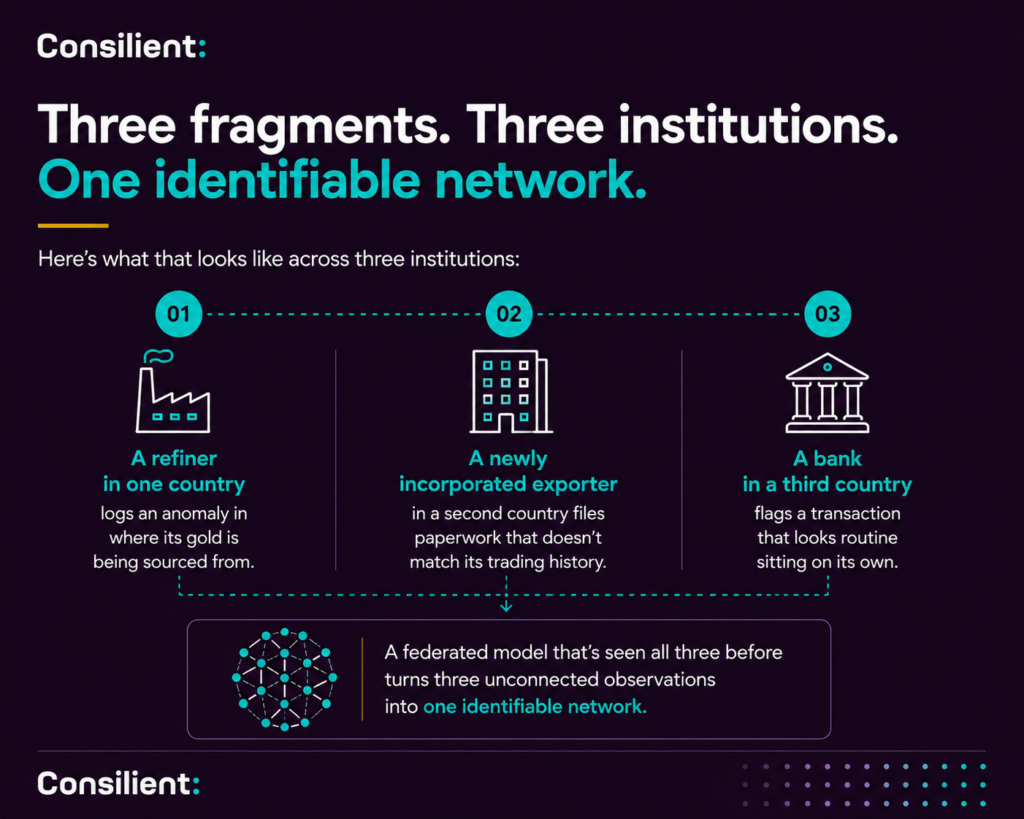
Once the physical origin of the gold becomes difficult to reconstruct, the remaining opportunity lies in the signals surrounding how it was sourced, financed, moved and monetized. Those signals sit across institutions. The challenge is connecting them without requiring those institutions to pool their underlying data. This is the collective intelligence case. Institutions train shared fraud detection models on distributed data, using mathematical representations of behavior, instead of the underlying customer or transaction data itself.
Here’s what that looks like across three institutions:
- 🟣A refiner in one country logs an anomaly in where its gold is being sourced from
- 🟣A newly incorporated exporter in a second country files paperwork that doesn’t match its trading history
- 🟣A bank in a third country flags a transaction that looks routine sitting on its own
Three fragments. Three separate institutions. No single owner.
What this means for trade finance and correspondent banking teams now
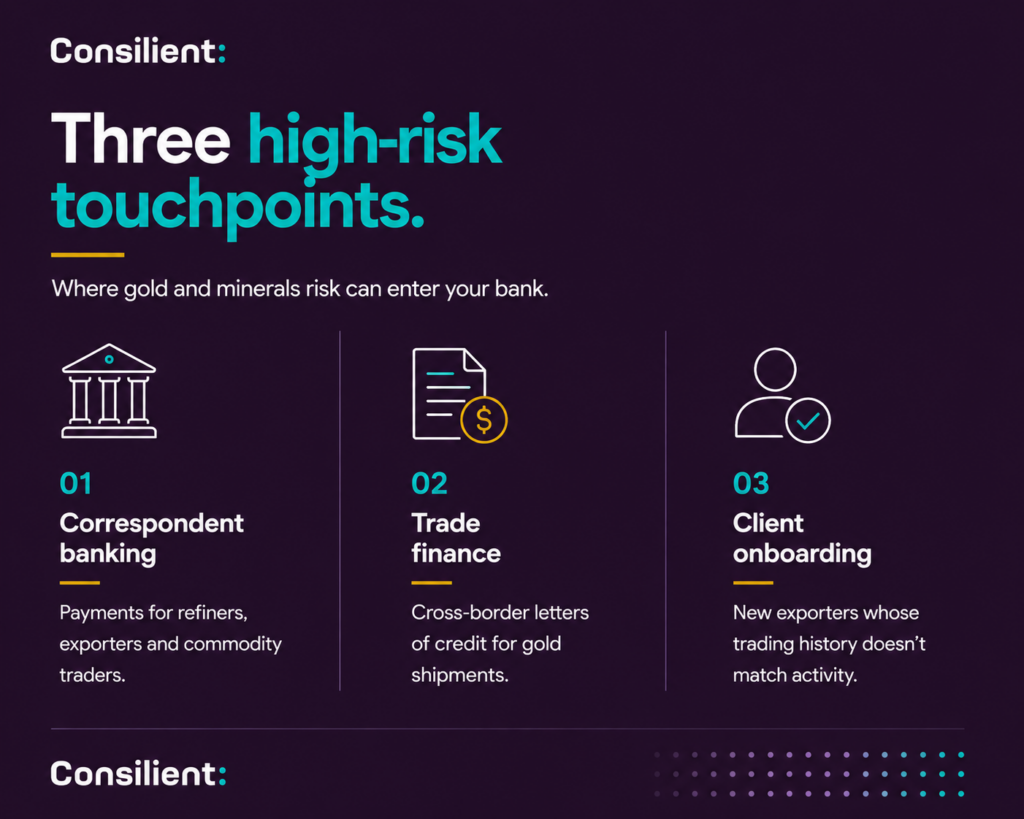
Gold and mineral-linked trade finance clients should expect more scrutiny under FATF’s public-private partnership push. Three groups are even closer to that scrutiny than they were 12 months ago:
- Correspondent banks clearing payments for refiners, exporters, or commodity traders based in minerals-producing jurisdictions
- Trade finance teams issuing letters of credit against gold or mineral shipments where the underlying documentation chain runs through more than one country
- Onboarding teams assessing newly incorporated exporters whose trading history doesn’t yet match the volume of gold they’re claiming to move
That last point carries the sharpest opportunity. A newly registered exporter receiving substantial inbound payments before it has a documented supply chain or an established customer base is a major anomaly. Given what UNODC has already mapped on false documentation and origin mislabelling, that combination reads close to the laundering mechanism itself, caught at the point it’s easiest to see. The detection opportunity is at onboarding, before the entity builds up a trading history that makes it look routine.
UNODC’s environmental crime framing and its financial crime framing now sit under the same reporting line. In most banks, the split still runs through the org chart: ESG and sustainability functions own gold sourcing questions, AML and financial crime functions own the laundering typologies. Both are now looking at the same data problem from two different desks, usually without a shared view of what the other has already found.
The institutions setting this agenda have already reached the same conclusion. Shared insights across institutions is the answer. The answer is not simply more data within each institution. It is the ability to learn across the fragments those institutions already hold, without requiring the underlying data to be pooled or exposed.
You may also like:
